Unfortunately it was a strict no photos allowed policy so I only have pictures of the outside.
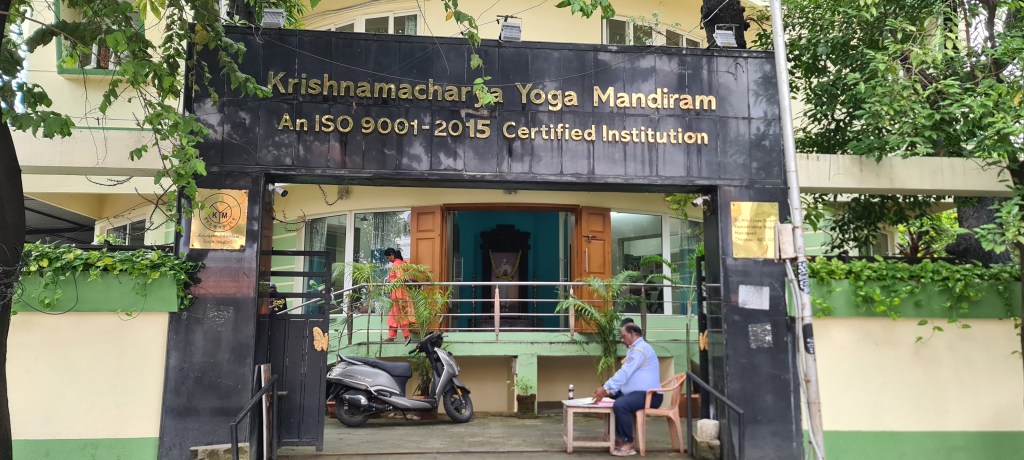
Ahh yoga in India – you’ll be tying yourself into pretzels in no time!
Well, not really. The point of this six day course was to explore the beliefs of yoga, to understand why we practice, and to go deeper into yourself. It was designed by my yoga teacher in conjunction with the mandiram and looked like this:
- 9.00 to 9.50 am – Chanting
- 10.00 to 10.50 am – Pranayama (breath practice)
- (tea break)
- 11.10 to 12.00 noon – Asana Practice (the poses that everyone thinks of when they think of yoga)
- (lunch)
- 2.00 to 2.50 pm – Yoga Philosophy
- (tea break)
- 3.10 to 4.00 pm – Meditative practice
Chanting was intense! It takes a lot of concentration to chant in another language, even just using three basic tones. (particularly when you are like me and are NOT musical at all!) Plus a few sounds we don’t have in English, such as a retroflex ‘n’ where you curl your tongue back as you say it. The idea is that when you chant you need to concentrate and can’t think of anything else, so it is a form of mediation. Obviously, when you are learning it’s just a bit overwhelming. And then they want to hear you solo! 😬 On the last morning, three of the teachers performed a couple of chants for us, which was just magical. Almost like waves washing over you.
Pranayama is about different breathing techniques which, according to yoga, helps link the external, physical to the internal. The idea is to calm and lengthen the breath as we are (apparently) only given a set number of breaths. We all are aware that when you are upset, one thing you can do to help calm you is to try to slow down your breathing – so it’s giving you tools to do that sort of thing. From simply being aware of the four parts of the breath (inhale, natural pause, exhale & natural pause) to counting, deliberate pausing after exhale and/or inhale, breaking the breath (so inhale, pause, inhale, pause, inhale) and alternate nostril breathing are all ways to extend the breath and, again, to help you focus inwards.
Asana practice was just before lunch and involved very simple postures. There were no fancy poses because firstly, there were no props allowed – just a mat. For those of you who have done yoga with a western body we often need bolsters, belts, and blocks so without them it’s a bit trickier. Secondly, with a group class, by the time you take into account everyone’s limitations, you will generally to end up with more gentle poses. Each pose is done six times, always with the breath. The point of this practice is that you will be able to sit still and mediate (for hours).
Immediately after lunch was Yoga Philosophy – so basically the model of the world according to this branch of yoga. There are many branches of yoga and the lineage from teacher to student is considered very important. The teacher we had also had a psychology degree so was able to link western ideas with the yoga ones which made it quite interesting. For example, the mandiram’s motto is roughly translated to “Avoiding the suffering that is yet to come” which is equivalent to “Prevention is better than cure”. While I am never going to believe in reincarnation, the connection between body and mind is very real so there were some good ways of thinking about that.
Lastly was mediation, which quite frankly didn’t appeal. The idea of sitting on the hard floor with just a mat and a couple of flat cushions for an hour in silence would just hurt my back. Luckily, it was not like that: instead we did a few basic poses, talked a bit about the five elements (water, earth, ether/space, air, fire) and then did a guided mediation. My favourite was earth where she talked about people needing the connection with the earth and when you are standing on the earth you are connected to all the other people through the earth. A really nice way to think about it!
The mandiram itself was a quiet, calm oasis in a loud and polluted city. The teachers were all lovely and had excellent knowledge of their subjects and (with the help of our yoga teacher who was also in the classes) adjusted to the needs of our group, which was great. It was an interesting insight into the thinking behind yoga and definitely left me feeling calmer.

 Country Hoppers